

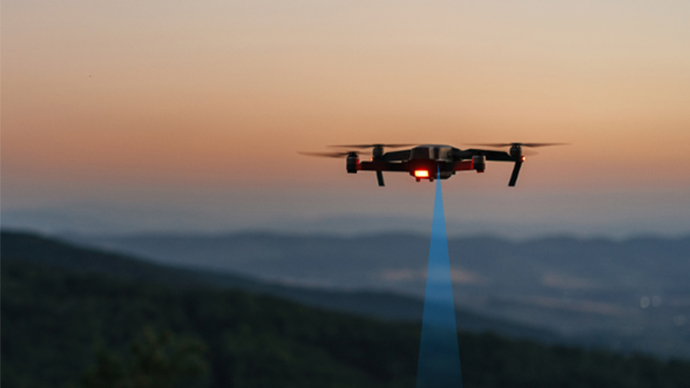
UAV
LiDAR Sensors for Drones or UAVs
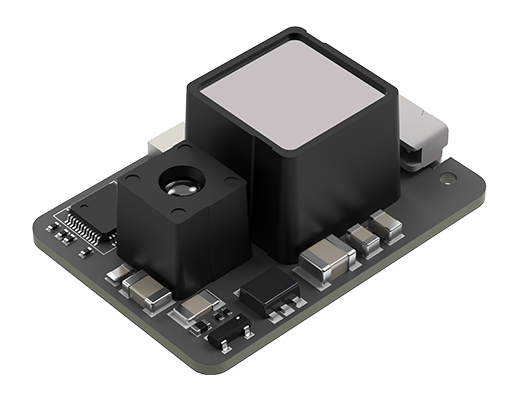
TFS20-L provides stable distance input for UAV altitude hold and terrain following. It suits missions that need mid-range coverage, protection, and reliable airframe integration; validate target reflectivity, ambient light, and vehicle attitude before operation.


Key specifications
Need help confirming a selection or purchase details?

| Parameter | Value | Parameter | Value |
|---|---|---|---|
| Measuring range | 0.2 ~ 20 m | Detecting accuracy | ± 6 cm (0.2 ~ 6 m), 1% (≥ 6 m) |
| Frame rate | 0 / 20 / 50 / 100 / 250 Hz | Interface | UART, I²C |
| Protection | Without enclosure | Dimensions | 21 mm × 15 mm × 7.87 mm |
| Power consumption | ≤ 0.43 W | Weight | ~ 1.35 g |
| Field of view | < 2° | Output data | Single-point Distance Value |
| Operating voltage | DC 3.3 ± 9% V |
Suitable for 20 m-class short-range measurement, robot obstacle avoidance and industrial automation sensing.
Condition: Bounded by the range, accuracy and operating conditions in the product datasheet.
TFS20-L is not intended for measurements beyond this model's datasheet range, accuracy or interface limits, and is not a substitute for certified redundant safety systems.
Condition: If the target requirement exceeds the specification boundary, complete a selection review or contact technical support first.
This topic addresses the requested 10–50 m selection question, but not every candidate reaches 50 m. Eliminate by real working distance first, then compare weight, enclosure, protection, interface and power.
View comparison topicTFS20-L is currently specified at 0.2–20 m, about 1.35 g and 3.3 V with UART and I²C, fitting payload-critical systems that provide their own structural protection.
Boundary: It has no enclosure, and low-reflectivity targets or strong ambient light reduce usable range; do not treat the 20 m headline as a guaranteed working distance in every site.
View model detailsTFmini Plus provides 0.1–12 m single-point ranging, IP65 and several board-level interfaces for compact equipment whose real distance stays in the short-range band.
Boundary: It is not a 50 m candidate; level or dusty applications also need separate checks for target surface, contamination, cleaning and maintenance.
View model detailsTF02-Pro is currently specified at 0.1–40 m, up to 1000 Hz and IP65 for tasks beyond 20 m that use UART, I²C or I/O.
Boundary: The 40 m figure is a specification boundary, not design margin for every target and environment; it is not native RS-485, so verify controller and cabling.
View model detailsTF02-Pro-W is currently specified at 0.1–25 m, RS-485, 7–30 V and IP5X, making it a candidate for industrial level tasks needing a bus and dust-oriented enclosure.
Boundary: IP5X is not a waterproof claim; account for its roughly 90–92 g weight and up-to-4.8 W power in mounting, supply, cleaning and maintenance.
View model details| Parameter | TFS20-L | TFmini Plus | TF02-Pro | TF02-Pro-W |
|---|---|---|---|---|
| Measuring range | 0.2 ~ 20 m | 0.1 ~ 12 m | 0.1 ~ 40 m | 0.1 ~ 25 m |
| Detecting accuracy | ± 6 cm (0.2 ~ 6 m), 1% (≥ 6 m) | ± 5 cm @ (0.1 ~ 5 m)± 1% @ (5 ~ 12 m) | ± 5 cm @ (0.1 ~5 m) ± 1% @(5 ~ 40 m) | ± 6 cm @ (0.1 ~ 6 m) ± 1% @ (6 ~ 25 m) |
| Frame rate | 0 / 20 / 50 / 100 / 250 Hz | 1 ~ 1000 Hz | 1 ~ 1000 Hz | 1 ~ 1000 Hz |
| Interface | UART, I²C | UART, I/O, I²C | UART, I/O, I²C | RS-485 |
| Protection | Without enclosure | IP65 | IP65 | IP5X |
| Dimensions | 21 mm × 15 mm × 7.87 mm | 35 mm × 18.5 mm × 21 mm | 69 mm × 41.5 mm × 26 mm | 85 mm × 59 mm × 43 mm |
| Power consumption | ≤ 0.43 W | 550 mW | ≤ 1 W | ≤ 4.8 W |
| Weight | ~ 1.35 g | 12 ± 1 g | 50 g | 90 ~ 92 g |
| Field of view | < 2° | 3.6° | 3° | 3° |
| Operating voltage | DC 3.3 ± 9% V | 5 ± 0.5 V | 5 ~ 12 V | DC 7 ~ 30 V |
The TFS20-L achieves a maximum range of 20 m at 90% reflectivity under low ambient light (0 Klux), dropping to 15 m in bright sunlight (100 Klux). For low-reflectivity targets (10%), the range is 12 m at 0 Klux and 9 m at 100 Klux. Minimum detectable distance is 0.2 m across all conditions.
The TFS20-L supports two communication protocols: UART at 115200 baud (8 data bits, 1 stop bit, no parity) and I²C at up to 400 kbps with slave-mode operation. The I²C default address is 0x10, configurable within the range 0x10–0x7F. Both use 3.3V LVTTL logic levels for direct microcontroller interfacing.
The TFS20-L is optimized for compact, power-constrained systems: drone altitude hold and obstacle detection, AGV/AMR proximity sensing, IoT distance monitoring, smart parking systems, and robotics. Its small form factor (21×15×7.87 mm) and ≤0.43 W power consumption make it ideal for battery-powered and embedded applications requiring extended flight or runtime.
The TFS20-L delivers ±60 mm (±6 cm) accuracy at 0.2–6 m range, improving to ±1% accuracy beyond 6 m. Precision (1σ repeatability) is 2 cm across the 0.2–6 m range. These specifications assume 25°C indoor conditions and 90% target reflectivity; environmental variation may degrade performance.
The TFS20-L operates from –20°C to +60°C with storage capability to –40°C to +85°C. It resists ambient light up to 100 Klux (equivalent to direct sunlight). However, the datasheet specifies 'N/A' for IP protection rating, meaning no sealed enclosure—not rated for dust or water ingress. Suitable for indoor or sheltered outdoor use only.
The TFS20-L requires DC 3.3 V ±9% (operating range 3.0–3.6 V) with average power consumption ≤0.43 W. Peak current during transmission is 130 mA at 3.3 V. This low power budget makes it compatible with standard 3.3V microcontroller supplies (Arduino, STM32, Raspberry Pi) without dedicated regulators.
The TFS20-L measures 21×15×7.87 mm and weighs approximately 1.35 g. It terminates with a 0.8 mm 6-pin connector (Model WF08006-01207), enabling easy integration into compact UAVs, robotic platforms, and handheld devices with minimal mechanical footprint and weight penalty.
The TFS20-L lacks IP rating and cannot withstand dust, moisture, or water spray—unsuitable for unprotected outdoor use, underwater applications, or high-vibration industrial settings. Its <2° field of view provides single-point ranging only, not 2D/3D scanning. In direct sunlight (100 Klux), maximum range reduces from 20 m to 15 m. Not suitable for safety-critical systems requiring sealed enclosures and FMEA certifications.
Both are single-point LiDAR modules for lightweight applications. The TFS20-L achieves 20 m range at 90% reflectivity (vs. LidarLite V3's ~40 m) but consumes less power (≤0.43 W vs. ~0.75 W). The TFS20-L supports dual UART+I²C communication and has a smaller form factor (21×15×7.87 mm vs. 22×29×14 mm) and lighter weight (1.35 g vs. ~3.8 g), favoring drone integration over long-distance ground applications.
The TFS20-L is compatible with Arduino, Raspberry Pi, STM32, ESP32, and other 3.3V microcontroller platforms via UART (115200 baud) or I²C (400 kbps) interfaces. It integrates with ROS via standard sensor drivers and autopilot systems like Pixhawk for altitude hold and obstacle avoidance through serial telemetry. PLC systems can interface via RS485 converters using the UART port.