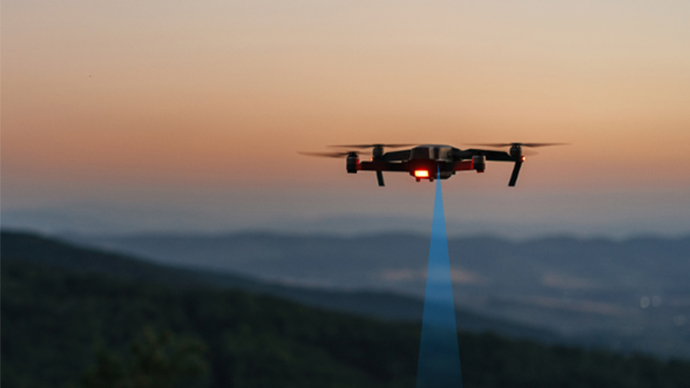
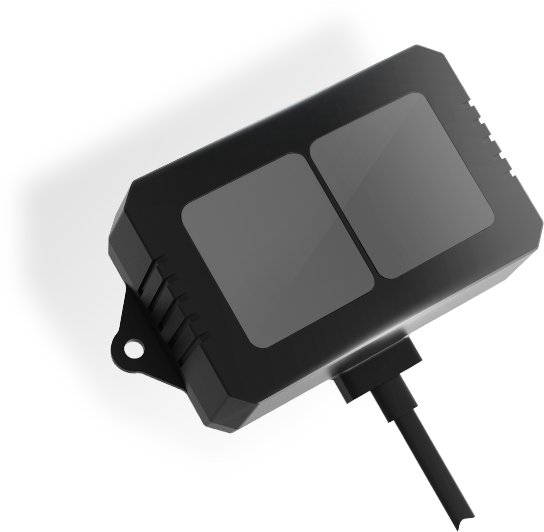

TF02-ProMid-range, high-protection LiDAR distance sensing for UAV altitude hold and terrain-following missions.
TF02-Pro suits UAV missions that need mid-range altitude input, IP65 protection, and a higher-rate distance signal. Verify target reflectivity, ambient light, interface, power, and airframe mounting; do not treat the maximum specification as a complete vehicle safety guarantee.
Compact Design
Strong Resistance To Ambient Light
Key specifications
- Measuring range
- 0.1 ~ 40 m
- Frame rate
- 1 ~ 1000 Hz
- Interface
- UART, I/O, I²C
- Protection
- IP65
Need help confirming a selection or purchase details?
Applications


UAV

Security Warning
Full specifications
| Parameter | Value | Parameter | Value |
|---|---|---|---|
| Measuring range | 0.1 ~ 40 m | Detecting accuracy | ± 5 cm @ (0.1 ~5 m) ± 1% @(5 ~ 40 m) |
| Frame rate | 1 ~ 1000 Hz | Interface | UART, I/O, I²C |
| Protection | IP65 | Dimensions | 69 mm × 41.5 mm × 26 mm |
| Power consumption | ≤ 1 W | Weight | 50 g |
| Field of view | 3° | Output data | Single-point Distance Value |
| Operating voltage | 5 ~ 12 V |
Applicable scope and usage limits
Applicable scenarios
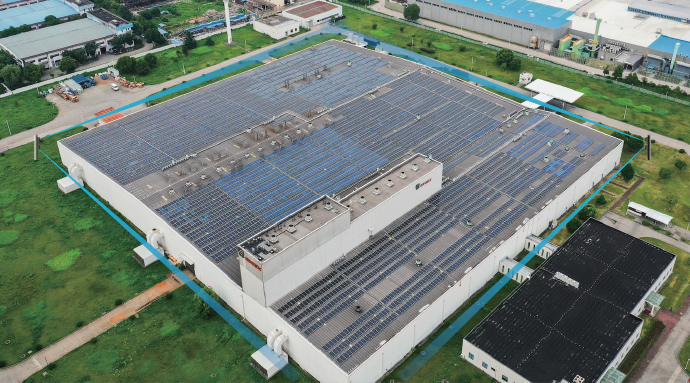
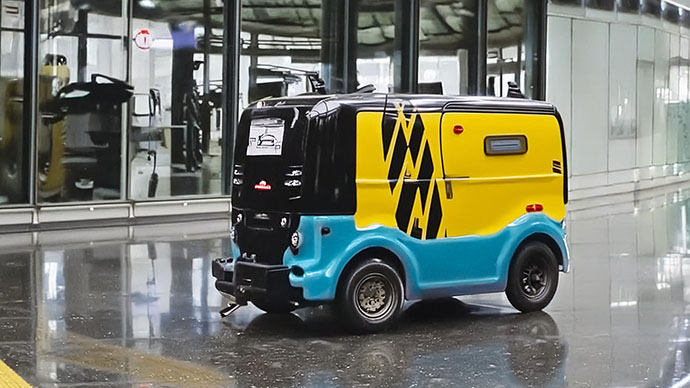
Suitable for outdoor industrial distance measurement, vehicle or robot obstacle avoidance and level detection.
Condition: Bounded by the range, accuracy and operating conditions in the product datasheet.
Not applicable
TF02-Pro is not intended for measurements beyond this model's datasheet range, accuracy or interface limits, and is not a substitute for certified redundant safety systems.
Condition: If the target requirement exceeds the specification boundary, complete a selection review or contact technical support first.
Choosing by industrial interface, power and distance
Confirm the controller interface, cable run and supply first, then compare range, update rate and protection. Model suffixes represent different interface paths; do not assume all three support the same buses.
View comparison topic12 m-class sensing over CAN or RS-485
TFmini-i is currently specified at 0.1–12 m, 7–30 V, CAN/RS-485 and IP65, fitting equipment that needs an industrial bus over a shorter range.
Boundary: Its listed maximum rate is 100 Hz; do not apply UART/I²C capabilities from other TFmini models to TFmini-i.
View model details40 m-class sensing with wide-voltage industrial buses
TF02-i is currently specified at 0.1–40 m and 7–30 V with CAN and RS-485, making it a candidate when more range and an industrial controller bus are required.
Boundary: Current product parameters do not state a protection rating; verify the delivered interface version, cabling, termination and site protection.
View model details40 m-class, high-rate UART/I²C/I/O integration
TF02-Pro is currently specified at 0.1–40 m, up to 1000 Hz and 5–12 V with UART, I²C and I/O, fitting controllers that use those interfaces directly.
Boundary: It is not a native CAN/RS-485 model; choose the corresponding variant or validate a conversion path rather than substituting by shape and range alone.
View model details| Parameter | TFmini-i | TF02-i | TF02-Pro |
|---|---|---|---|
| Measuring range | 0.1 ~ 12 m | 0.1 ~ 40 m | 0.1 ~ 40 m |
| Detecting accuracy | ± 6 cm @ (0.1 ~6 m) ± 1% @ (6 ~12 m) | ± 5 cm @ (0.1 ~ 5 m) ± 1% @ (5 ~ 25 m) | ± 5 cm @ (0.1 ~5 m) ± 1% @(5 ~ 40 m) |
| Frame rate | 1 ~ 100 Hz | 1 ~ 100 Hz | 1 ~ 1000 Hz |
| Interface | CAN, RS-485 | CAN, RS-485 | UART, I/O, I²C |
| Protection | IP65 | Not specified | IP65 |
| Dimensions | 50 mm × 34 mm × 41 mm | 69 mm × 40.5 mm × 31.5 mm | 69 mm × 41.5 mm × 26 mm |
| Power consumption | ≤ 0.8 W @ 12 V | ≤ 0.85 W @ 12 V | ≤ 1 W |
| Weight | 52 g | 60 g | 50 g |
| Field of view | 2° | 3° | 3° |
| Operating voltage | 7 ~ 30 V | 7 ~ 30 V | 5 ~ 12 V |
Integration
2 platforms with 5 installation, configuration and code resources.
ArduPilot
1 resourcePX4
4 resourcesTF02-Pro with PX4 I²C / UART / TTL / UART: integration and configuration guide
Setup, connection, configuration and code guidance for TF02-Pro with PX4. The original files are available in Materials and downloads. Documented interface: I²C, UART / TTL, UART.
I²C, UART / TTL, UART · 2026-08-31View integration resource →PX4TF02-Pro, TF02-Pro-W with PX4 I²C / CAN / UART: integration and configuration guide
Setup, connection, configuration and code guidance for TF02-Pro, TF02-Pro-W with PX4. The original files are available in Materials and downloads. Documented interface: I²C, CAN, UART.
I²C, CAN, UART · 2026-08-31View integration resource →PX4TF02-Pro, TF02-Pro-W with PX4 UART / TTL / CAN / UART: integration and configuration guide
Setup, connection, configuration and code guidance for TF02-Pro, TF02-Pro-W with PX4. The original files are available in Materials and downloads. Documented interface: UART / TTL, CAN, UART.
UART / TTL, CAN, UART · 2026-08-31View integration resource →PX4TF02-Pro with PX4 UART / TTL / UART: integration and configuration guide
Setup, connection, configuration and code guidance for TF02-Pro with PX4. The original files are available in Materials and downloads. Documented interface: UART / TTL, UART.
UART / TTL, UART · 2026-08-31View integration resource →FAQ
What is the maximum measurement range of the TF02-Pro?
The TF02-Pro can measure distances up to 40 m at 90% reflectivity (e.g., white surfaces), with a minimum range of 0.1 m. At 10% reflectivity (dark surfaces), the maximum range is 13.5 m. Range performance varies depending on target reflectivity and ambient light conditions (tested at 0 Klux indoors and 100 Klux outdoors).
What communication interfaces does the TF02-Pro support?
The TF02-Pro supports both UART and I²C interfaces. UART operates at a default baud rate of 115,200 bps with 8 data bits and 1 stop bit, while I²C operates at up to 400 kbps in slave mode with a default address of 0x10 (configurable from 0x01 to 0x7F). Both interfaces use LVTTL (3.3 V) logic levels.
What are the primary applications and use cases for the TF02-Pro?
The TF02-Pro is designed for UAV altitude hold, intelligent transportation, intelligent parking, and material level monitoring applications. Its 40 m range, high frame rate (up to 1000 Hz), and ambient light immunity (up to 100 Klux) make it suitable for both indoor and outdoor robotic systems, vehicle height detection, and industrial sensing tasks.
What accuracy and precision can I expect from the TF02-Pro?
The TF02-Pro delivers ±5 cm accuracy at distances from 0.1 m to 5 m, and ±1% accuracy from 5 m to 40 m. Distance resolution is 1 cm, with repeatability of <2 cm (1σ) for measurements from 0.1 m to 35 m at 90% reflectivity. Specifications are based on measurements at 25°C with standard white board reflectance.
How does the TF02-Pro perform in outdoor and harsh environmental conditions?
The TF02-Pro has an IP65 enclosure rating and operates in ambient light up to 100 Klux, making it suitable for bright outdoor environments. It functions reliably across temperatures from −20°C to +60°C, with storage capability from −30°C to +80°C. Its optimized optical system and algorithm enhance performance in the presence of varying reflectivity backgrounds and temperature changes.
What power supply and power consumption requirements does the TF02-Pro have?
The TF02-Pro requires a DC power supply of 5 V to 12 V. Average current consumption is ≤200 mA with total power consumption ≤1 W, while peak current during operation reaches 300 mA. This low power profile makes it ideal for battery-powered applications like drones and portable robotic systems.
What are the physical dimensions and weight of the TF02-Pro?
The TF02-Pro measures 69 mm (length) × 41.5 mm (height) × 26 mm (width) and weighs 50 g including an 80 cm cable. Its compact and lightweight design allows for easy integration into space-constrained applications such as UAVs, mobile robots, and handheld industrial tools.
In what scenarios should the TF02-Pro NOT be used?
The TF02-Pro should not be used for targets with extremely low reflectivity (<10%) beyond 13.5 m, as range performance degrades significantly. It is not suitable for high-speed rotating applications requiring frame rates above 1000 Hz or for safety-critical autonomous systems where IEC 61508 certification is mandated (it is Class 1 per IEC60825 laser safety only). Additionally, it should not be deployed in environments exceeding −20°C to +60°C operating range or indoors with zero ambient light where its 100 Klux immunity provides no advantage.
How does the TF02-Pro compare to other single-point LiDAR sensors?
The TF02-Pro offers a cost-effective alternative in the mid-range segment: compared to Garmin LidarLite V3 (40 m range, ±10 cm accuracy), the TF02-Pro achieves better accuracy at close range (±5 cm from 0.1–5 m) and maintains ±1% accuracy beyond 5 m; compared to Lightware LW20/LW20-100 series (120 m range), the TF02-Pro trades maximum range for lower cost and better outdoor ambient light immunity. The TF02-Pro's 100 Klux ambient light resistance and up to 1000 Hz frame rate align it with Benewake's own TFmini-Plus, but TF02-Pro extends the range to 40 m versus TFmini-Plus's 12 m maximum.
What platforms and integration ecosystems support the TF02-Pro?
The TF02-Pro integrates with Arduino boards via UART/I²C, supports ROS (Robot Operating System) through standard serial drivers, and is compatible with Pixhawk autopilot systems for UAV altitude control. Its UART and I²C interfaces allow integration with PLC systems, industrial controllers, and embedded Linux platforms (Raspberry Pi, Jetson Nano). Benewake provides UART and I²C protocol documentation for custom firmware development on any embedded platform with standard serial communication capabilities.
How can I switch a sensor back to UART when it is in I2C mode and I have no I2C tool?
Use a USB-to-I2C adapter such as CH341 and BW_CheckWINCC to send the switch command. Some models also support the hardware method on PIN5. TFmini-S, TFmini Plus, and TF02-Pro commonly select I2C with PIN5 tied to GND; follow the model manual to remove that connection or send the matching command when returning to UART.