
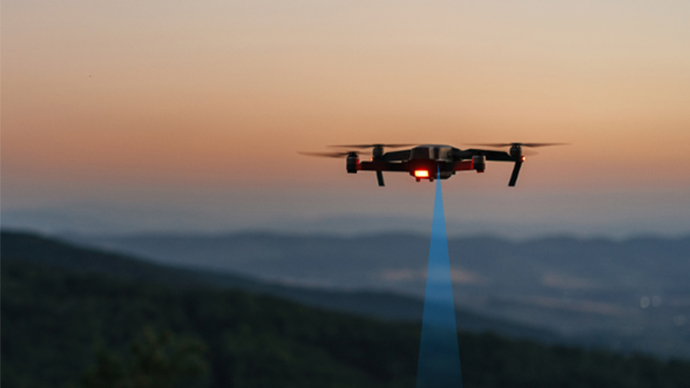
UAV
LiDAR Sensors for Drones or UAVs
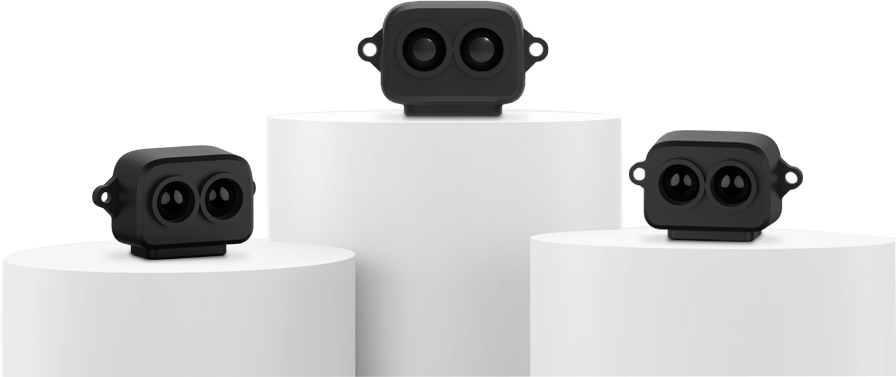
TF-Luna LiDAR offers stable, accurate range measurement via ToF technology. This single-point LiDAR range sensor highlights adapted algorithms and adjustable configurations to ensure accurate distance sensing performance in diverse environments.
Key specifications
Need help confirming a selection or purchase details?

| Parameter | Value | Parameter | Value |
|---|---|---|---|
| Measuring range | 0.2 ~ 8 m | Detecting accuracy | ± 6 cm @ (0.2 ~ 3 m) ± 2% @ (3 ~ 8 m) |
| Frame rate | 1 ~ 250 Hz | Interface | UART, I/O, I²C |
| Protection | Without enclosure | Dimensions | 35 mm × 21.25 mm × 12.5 mm |
| Power consumption | ≤ 0.35 W | Weight | < 5 g |
| Field of view | 2° | Output data | Single-point Distance Value |
| Operating voltage | 3.7 ~ 5.2 V |
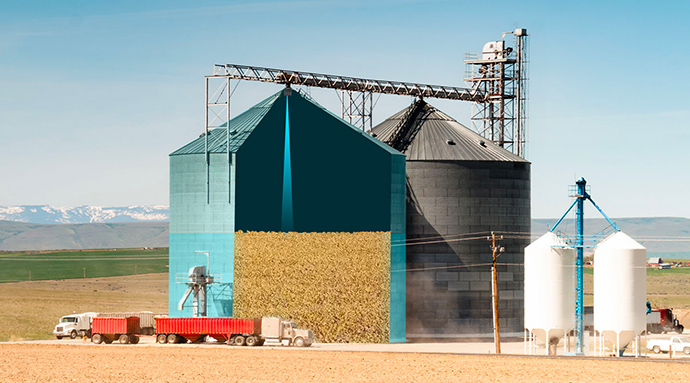
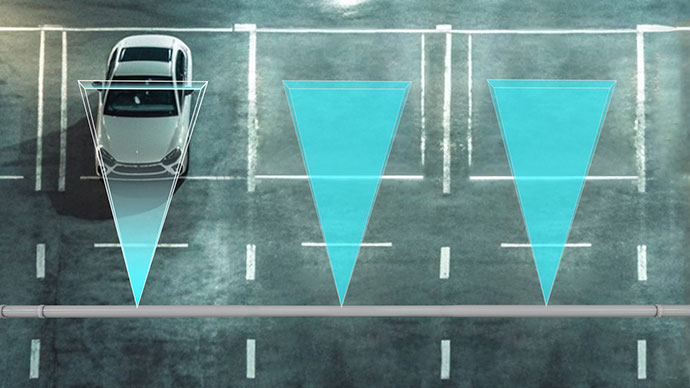
Suitable for medium/short-range measurement, robot obstacle avoidance, and liquid or material level detection.
Condition: Bounded by the range, accuracy and operating conditions in the product datasheet.
TF-Luna is not intended for measurements beyond this model's datasheet range, accuracy or interface limits, and is not a substitute for certified redundant safety systems.
Condition: If the target requirement exceeds the specification boundary, complete a selection review or contact technical support first.
All three models output one distance point. Check target reflectivity, real distance, mounting environment and power first, then compare weight, power, protection and field of view; the same headline range does not imply the same result for every target or environment.
View comparison topicTFmini-S is about 5 g and is currently specified at 0.1–12 m with rates up to 1000 Hz and UART, I²C and I/O, fitting payload- and space-constrained single-point ranging.
Boundary: Usable range changes with target reflectivity and environment; current material does not state an enclosure protection rating, so outdoor use needs system-level protection and mounting validation.
View model detailsTFmini Plus is also a 0.1–12 m single-point sensor; current parameters list IP65 and a 3.6° field of view. Consider it when the platform can accept about 12 g and those protection and coverage traits matter.
Boundary: A wider field of view is not scanning or multi-channel output; dark targets, strong ambient light and out-of-range readings still require validation against specified conditions.
View model detailsTF-Luna is currently specified at 0.2–8 m, under 5 g and no more than 0.35 W, fitting short-range single-point input in a controlled mounting position.
Boundary: 3.3 V refers to the communication logic level, not the specified supply; the supply range is 3.7–5.2 V, and an unenclosed installation needs separate protection.
View model details| Parameter | TFmini-S | TFmini Plus | TF-Luna |
|---|---|---|---|
| Measuring range | 0.1 ~ 12 m | 0.1 ~ 12 m | 0.2 ~ 8 m |
| Detecting accuracy | ± 6 cm @ (0.1 ~ 6 m)± 1% @ (6 ~ 12 m) | ± 5 cm @ (0.1 ~ 5 m)± 1% @ (5 ~ 12 m) | ± 6 cm @ (0.2 ~ 3 m) ± 2% @ (3 ~ 8 m) |
| Frame rate | 1 ~ 1000 Hz | 1 ~ 1000 Hz | 1 ~ 250 Hz |
| Interface | UART, I/O, I²C | UART, I/O, I²C | UART, I/O, I²C |
| Protection | Not specified | IP65 | Without enclosure |
| Dimensions | 42 mm × 15 mm × 16 mm | 35 mm × 18.5 mm × 21 mm | 35 mm × 21.25 mm × 12.5 mm |
| Power consumption | ≤ 0.7 W | 550 mW | ≤ 0.35 W |
| Weight | 5 ± 0.3 g | 12 ± 1 g | < 5 g |
| Field of view | 2° | 3.6° | 2° |
| Operating voltage | 5 ± 0.1 V | 5 ± 0.5 V | 3.7 ~ 5.2 V |
4 platforms with 8 installation, configuration and code resources.
Setup, connection, configuration and code guidance for TF-Luna with ArduPilot. The original files are available in Materials and downloads. Documented interface: I²C, CAN.
I²C, CAN · 2026-08-31View integration resource →ArduPilotSetup, connection, configuration and code guidance for TF-Luna with ArduPilot. The original files are available in Materials and downloads. Documented interface: I²C, CAN, UART / TTL, UART.
I²C, CAN, UART / TTL, UART · 2026-08-31View integration resource →ArduPilotSetup, connection, configuration and code guidance for TF-Luna, TF series LiDAR with ArduPilot. The original files are available in Materials and downloads. Documented interface: I²C, CAN, UART / TTL, UART.
I²C, CAN, UART / TTL, UART · 2026-08-31View integration resource →Setup, connection, configuration and code guidance for TF-Luna with Arduino. The original files are available in Materials and downloads. Documented interface: CAN, UART.
CAN, UART · 2026-08-31View integration resource →ArduinoSetup, connection, configuration and code guidance for TF-Luna with Arduino. The original files are available in Materials and downloads. Documented interface: I²C, UART.
I²C, UART · 2026-08-31View integration resource →Setup, connection, configuration and code guidance for TF-Luna with Raspberry Pi. The original files are available in Materials and downloads. Documented interface: UART.
UART · 2026-08-31View integration resource →Raspberry PiSetup, connection, configuration and code guidance for TF-Luna with Raspberry Pi. The original files are available in Materials and downloads. Documented interface: CAN, UART.
CAN, UART · 2026-08-31View integration resource →The TF-Luna operates from 0.2m to 8m with 90% reflectivity in both indoor and outdoor conditions, and 0.2m to 2.5m with 10% reflectivity. Range varies based on target reflectivity and ambient light; the 8m maximum assumes a standard white board (90% reflective) tested indoors at 25°C. For lower-reflectivity targets (10%), maximum range drops to 2.5m.
The TF-Luna supports three interfaces: UART (default 115200 baud, adjustable), I²C (slave mode with 400kbps maximum transmission rate and default address 0x10), and I/O. The communication level is LVTTL (3.3V logic), and the I²C address range is 0x08–0x77, allowing multiple sensors on the same bus.
The TF-Luna is optimized for auxiliary focus (camera autofocus), elevator projection (cabin detection), intrusion detection, and level measurement (silo/tank monitoring). Its small size (<35mm length), low power (<0.35W), and high frame rate (up to 250Hz) make it ideal for compact systems like UAVs, AGVs, and IoT devices where space and power are constrained.
The TF-Luna delivers ±6cm accuracy at distances 0.2m–3m and ±2% accuracy from 3m–8m, with a distance resolution of 1cm. These specifications are based on indoor testing with a standard white board (90% reflectivity) at 25°C, representing best-case conditions for high-reflectivity targets.
Operating temperature ranges from -10°C to +60°C, with storage temperature from -20°C to +75°C. The sensor has no formal IP rating but uses ABS+PC housing. It tolerates ambient light up to 70Klux (approximately outdoor daylight equivalent) without range degradation, making it suitable for both indoor and outdoor deployment.
The TF-Luna requires a 3.7V–5.2V supply with average current ≤70mA and peak current of 150mA, consuming ≤0.35W on average. This low power budget enables integration into battery-powered systems including drones, mobile robots, and handheld devices without significant power management concerns.
The TF-Luna measures 35mm (L) × 21.25mm (W) × 12.5mm (H) and weighs less than 5g, making it one of the most compact single-point LiDAR modules. Its minimal footprint and weight make it ideal for space-constrained applications like UAV payload integration and embedded IoT systems.
The TF-Luna has a narrow 2° field of view and measures only single points, so it cannot create 2D or 3D maps—unsuitable for mapping or SLAM applications requiring spatial imaging. It also degrades significantly on low-reflectivity targets (<20%), limiting range to 2.5m; not recommended for dark surfaces, transparent materials, or long-distance outdoor applications requiring >8m range. Peak current spikes (150mA) may stress power-limited systems.
The TF-Luna is more compact (35×21.25×12.5mm vs. larger scanning lidar modules) and lower cost, with single-point measurement up to 8m at 90% reflectivity. However, it lacks the 2D scanning capability of devices like the Lightware SF45 and operates in narrower conditions (2° FOV vs. wider scanning fields). For range-only applications requiring small size and low power, TF-Luna competes on compactness; for mapping-capable sensors, it serves different use cases.
The TF-Luna integrates with Arduino (UART/I²C via serial shields), ROS (community drivers available for UART), Pixhawk autopilots (via rangefinder MAVLink protocol over UART), and industrial PLCs (via UART/I²C) through standard communication protocols. The LVTTL (3.3V) logic level is compatible with most microcontroller ecosystems; users may need level shifters for 5V systems. Default UART at 115200 baud and I²C slave at 0x10 are immediately usable in embedded and robotics stacks.
Use a USB-to-I2C adapter such as CH341 and BW_CheckWINCC to send the switch command. Some models also support the hardware method on PIN5. TFmini-S, TFmini Plus, and TF02-Pro commonly select I2C with PIN5 tied to GND; follow the model manual to remove that connection or send the matching command when returning to UART.
Check the I2C selection state on PIN5, the default address 0x10, and the Pixhawk parameters RNGFND1_TYPE=20 and RNGFND1_ADDR=0x10. Share a common ground, keep the I2C cable at or below 40 cm where possible, and verify power, pull-ups, and wiring order.
Yes. It is a confirmed firmware issue in v3.3.1: the register can read 0x0000 regardless of the actual frame rate. It is fixed in v3.5.1; update early-batch devices according to the model upgrade instructions.
TF-Luna