Solution

LiDAR application solution for shuttle vehicle and AGV/AMR obstacle avoidance

Provide forward obstacle distance in warehouse aisles and connect it to slowdown zones and stopping logic.

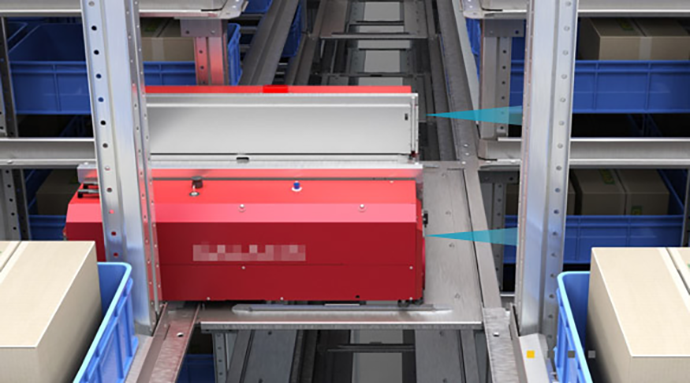
Shuttle vehicle detecting obstacles in a warehouse aisle

Scenario

Application scenario

Shuttle vehicle and AGV/AMR obstacle avoidance must be designed across aisle geometry, mounting, field of view, control latency, and stopping distance. LiDAR provides distance; it does not complete a safety stop by itself.

Engineering problem

  • Beams, cartons, and low obstacles may occupy different heights.
  • Speed, payload, and floor conditions change the real stopping distance.
  • Occlusion, dark targets, and strong light require validation in the real aisle.

Why LiDAR

A point LiDAR can provide continuous direct distance along the target direction for slowdown and stopping logic. A complete safety system still needs control, redundancy, and field validation.

Workflow

  1. Define the hazard zone, vehicle speed, control period, and stopping margin.
  2. Choose a mounting height and direction that covers targets without vehicle occlusion.
  3. Integrate distance and status into staged slowdown and stop logic.
  4. Test real targets, lighting, floors, and maximum payload and record the limits.

Technology comparison and selection

DimensionConditionLiDARAlternativeAlternative performanceConclusion
Forward obstacle range inputCompare on the real target, mounting path, environment, control logic, and project acceptance criteria; do not compare nominal maximum range alone.Provides range or area-change input inside the validated field of view.Contact bumper / point switchUsually trigger on contact or at a fixed point only.

Define slowdown and stopping with sensing coverage, speed, braking distance, and safety architecture together.

公开来源公开来源 · Verified 2026-08-24

Scroll horizontally to view all columns

Installation and integration

  • Define the target, measurement axis, occlusion, wiring, and mounting space first; connect the current product manual to the target controller and record the model, interface, orientation, offset, and delivered revision.

    AGV/AMR obstacle-avoidance solution · Target controller or host system · Target hardware and software release verified before deploymentTF-NOVA Datasheet · Verified 2026-08-24
  • Before connecting business control logic, validate healthy data, timeout handling, stop behavior, and fallback with real targets, worst-case distance, ambient light, and motion.

    AGV/AMR obstacle-avoidance solution · Target controller or host system · Field procedure and fault handling verified on the target systemTF-NOVA Datasheet · Verified 2026-08-24

Operating limits

  • LiDAR provides distance or spatial-sensing input and does not by itself provide system positioning, safety integrity, braking, flight-stack fusion, or business outcomes; design and validate those functions separately on the target system.

    AGV/AMR obstacle-avoidance solutionTF-NOVA Datasheet · Verified 2026-08-24

Sources

Supporting sources

Verifiable TF-NOVA reference

Current material verifies line-pattern beam, ranging conditions, and interfaces; the page does not promise vehicle avoidance outcomes. The current public material supports verification of sensor specifications and interfaces; it does not establish vehicle-level performance, system safety level, or project results.

Use the stated target, reflectivity, ambient-light, mounting, and delivered-revision conditions; revalidate in the field.

TF-NOVA Datasheet

FAQ

Frequently asked questions

Can a LiDAR obstacle reading be used directly as the AGV safety stopping distance?

No. Distance is an input. Speed, payload, braking, control latency, mounting blind zones, and safety margin still determine the stopping distance and require system-level validation.

Resources

Resources and references

Confirm the selection with real mission conditions

Share the operating height, target surface, environment, mounting space, and flight-stack version. Our engineering team can help plan selection and validation.

Talk to an engineer

Product inquiry

Talk to a product specialist

Tell us what you need and our team will get back to you.

Product inquiry

Inquiry sent

Your inquiry has been received. We will be in touch soon.